Monday, January 16, 2017

When in Rome...

Although our trip to Rome started later than planned because of bus delays, it turned out to be an eventful day once it got going. After our three hour bus ride, we arrived at the hotel in Rome. After we checked in, we began our tour of the capital of the world.

The first stop was the Colosseum, a Flavian amphitheater capable of holding up to 55,000 people, which was built between 72 - 80 CE by the Flavian Dynasty next to Nero's Palace as a testament to his greed. The reason why this amphitheater has remained in such good condition is because of its multitude of arches which signify triumph and help keep the building sturdy. The Colosseum had many functions including entertainment as a part of the patron-client system, political value, and creating a sense of community. Additionally, the games were a way for politicians to gain votes and get public recognition. The games were also a demonstration of Rome's ability to conquer others. Perhaps most importantly, the Colosseum served as a means by which social hierarchies were established. For example, royalties and Vestal Virgins had the privilege of sitting in the bottom seats while those lower down on the social class had seats near the top.

In regard to the games held in the Colosseum, the first half of the day was typically reserved for animals fighting other animals with the occasional gladiator on animal fight. The middle part of the day incorporated the audience by having drawings for door prizes, songs, shows, and executions. The afternoon was reserved for gladiator battles and was the part of the day that everyone looked forward to. Gladiators tended to be outcasts or slaves and were forced to fight for their freedom. Gladiator battles taught moral values by demonstrating the nobility of death and the gladiators lack of fear of death. Although everyone loved to watch the fights, the emperors sometimes limited the amount of gladiator paris to avoid being ostentatious and demonstrating a lack of virtue.

Next we walked through the Arch of Titus to enter the ancient Roman forum. The forum was originally swamp land, but it was drained by the Etruscans in the 7th century BC with the intent of using the space as a market place. This atypical forum boasts of two basilicas along with the House of Vestal Virgins, which is an ancient religious cult central to the identity of Rome as a republic and an empire. Girls were brought into the cult as early as the age of 12, upon which they were seen as women. Members of the cult could supposedly feel when Rome was threatened, which is why they were viewed as so important. These women remained priestesses for thirty years, during which they were required to retain their virginity upon threat of being buried alive. Next to the House of Vestal Virgins was a temple to the goddess Vesta, who symbolized the hearth and the home. The Romans viewed the home and family values as central to the foundation of the empire.

Next Lynn showed us one of her favorite spots, the cloaca maximum. (Fun fact, cloaca means bird poop hole.) This was not only used for a sewage, but also to divert the water of the marsh land into the Tiber River. Romans valued water systems because they saw them as a way to control nature, so they outlined the cloaca maximum with marble in order to show its importance.

We wrapped up our tour of the forum by observing the Temple of Concord and Temple of Saturn, which are the two oldest temples in the forum. We also took a look at the curia, which was built in 44 BCE and served as one of three center buildings in Rome along with the Senate building. Since then, the curia has undergone several renovations and has been kept as a church. Inside of the curia there is an image of Emperor Tiberius forgiving people who have to pay off their debts.

Our last stop of the day was the monument to King Victor Emanuel, also known as the Victorian and the "altar of the nation". Started in the 1890's and finished in the 1920's, this massive monument was designed to give Italians a sense of unity. Complete with a 50 ton statue of King Emanuel riding his horse to meet Garibaldi to get the key to the city, the monument also includes four statues of women on top of the building which are meant to depict the four different regions of the Italian state. There is a fountain located on each side of the monument which symbolizes the two seas that surround Italy, the Mediterranean and the Adriatic.

Overall, we had a great day, and we can't wait to see what else Rome has in store for us.

- Bailee & Zach

Sunday, January 15, 2017

Our Rainy Day in Pompeii

Today was the day we journeyed back to 79 CE, when we visited the ancient preserved city of Pompeii. When Mount Vesuvius erupted, Pompeii was buried in 25 meters of ash, becoming a city frozen in time, until early excavations during the reign of King Charles of the Bourbon Dynasty led to its rediscovery.

As we trudged up the steep hill to the entrance of the city, we walked on large cobblestones wet from the rain, admiring the many sites where homes once stood and families once lived. Pompeii originated as a port city, with close trade relations with many lucrative civilizations, such as the Greeks, Phoenicians, and Romans. The city attracted wealthy tourists even then, and much like the city of Naples we are staying in now, Pompeii was a very large, urban area. The population ranged between 11,000 and 12,000, but somewhat unfortunately, we only saw two petrified bodies today.

The city was founded by the Oscans but in the 5th century BCE was captured by the Samnites. The Samnites had a complicated relationship with Rome and ultimately revolted against Rome in the year 80 BCE, and after their failure became a part of the Roman Empire. From that point on, there was a period of “Romanization” in Pompeii, which is evident in the forum in the center of the city that reflects the styles of their Roman counterparts.

In 62 CE, an earthquake rocked the city, prompting renovations that were never finished because, in 79 CE, Mount Vesuvius erupted and stopped the developing city in its tracks. Over many years since its discovery, patrons have attempted to renovate the city without using proper tools and processes, and after years of this kind of mismanagement and misallocation of funding, the ruins fell into a state of disrepair in the early 21st century. A recent surge in funding from UNESCO has stimulated proper restoration of the ruins. Today we saw many projects that were still developing, and it looks like the city is on its way to recapturing some of its former glory. The city was remarkably intact, and walking through the streets left us with an undeniable nostalgia and eerie sense that the city was still alive.  

First, we saw the Temple of Apollo, which was built in the 2nd century BCE, and was a hybrid of Greek and Roman architectural styles. Outside of the temple would have been the standard for weights and measures, alongside a smaller altar used for grain and incense sacrifices for the gods. In the center, the cella could still be identified, which would have been the room containing Apollo’s statue and the city treasury.  

Next, we toured the city’s basilica, which would have been a two-story building that regulated government affairs and was most likely bordered by other government buildings. It was surrounded by columns that mixed the Greek Ionic and Corinthian styles and was filled with large cult statues.

Afterwards, we meandered through the forum, which contained the Temple of Jupiter, an important feature of religious life in the city. Also within the forum was a statue to commemorate Eumachia, the patron of the Guild of the Fullers, which would have been similar to a worker’s union for artisans who tanned hides. Eumachia gives us insight into the role of women in the city, some of whom were independently wealthy.

Another feature within the forum was the Acanthus, which was an ornate sort of door frame that showed different scenes from nature all tied together with images of leaves. This was a standard motif in Augustan era art and was a way for the people of Pompeii to show their allegiance to and love for the Emperor Augustus (today, we would just put an “I <3 Augustus” bumper sticker on the back of our cars).

We also visited many smaller homes and the marketplace, which served as the center of city activity and featured common styles of frescoes on the walls that could also be seen in large urban homes. Historians have decided that Pompeii had three dominant styles of art with three different purposes: to replicate different types of architecture, to create visual illusions, and to decorate homes and public areas.

Beyond the necropolis at the edge of the city, we entered the more suburban section of Pompeii and toured the “Villa dei Misteri”, whose owner is debated, but is speculated to have been a freed slave. The room that gives this Villa its name is the triclinium, which is believed to have been the private dining room of the family. The wall features a large fresco, immaculately preserved and depicting the initiation process into the cult of Dionysus. The cult of Dionysus was considered a “mystery religion” because it cannot be understood until you are formally initiated into it. Mystery religions were criticized for being primarily associated with women, as well as for their foreign and secretive nature. There were many mystery religions during this time, one of which was an early form of Christianity.

Our final stop was one of an estimated 30 city brothels, which was treated slightly differently in Pompeii’s society than it would be now, as prostitution was a taxed, legitimized form of work, often performed by slaves or other poor citizens. Men were nearly expected to visit the brothel, though not excessively, but the stigma around the prostitutes themselves still remained. Many of the erotic frescoes we saw in yesterday’s museum were found in these brothels.

After touring this ancient city in rainy, cold weather, we were eager to return to the warmth of our hotel rooms, but were side(train)tracked (ha, PUNpeii) when our train did not arrive and we were forced to wait in freezing rain and wind for another train to safely deliver us through the metro system, back to Via Toledo.

Even though the weather was miserably cold (and Mike had no sympathy for us (and Erin cried a little)), touring these ancient ruins warmed our hearts and minds with knowledge.

Peace, love, and Pompeii,

Mary and Erin

P.S. Tomorrow, we will finally be able to appropriately use the phrase “when in Rome” on our Instagram captions! 

Saturday, January 14, 2017

Marble, Mosaics, and Metros

With nearly a week left, our excursion into the mainland of Italy began. Naples is a distinctly different metropolitan area from Syracuse and the rest of Sicily; however, it has its own merits. Over the course of the day, we were able to see the local castle, the Palazzo Royale, the Duomo of Naples, and explore the National Museum of Archaeology.

Both the military purposes of the castle and the ornate decoration of the palace, among other attributes, helped us compare and contrast the two buildings to better understand their respective roles within the community of Naples. We followed their creation and how their succession of leaders are communicated through the design and purpose. Displayed within the palace was an elaborate nativity scene comprised of detailed figurines. Today, Naples is famous for similarly designed figurines.

Our first ride on the metro went smoothly, and we made our way to the Duomo. Once a temple to a Greek deity (Athena??), it was later converted into a breathtaking example of a Baroque-style cathedral dedicated to Saint Gennaro. We were able to see one of the earliest European baptisteries (created in the 5th century) and noted its symbolic depictions of Biblical figures and its proximity to the street, which may have been designed to increase the access to conversion for those in the area.

After a two-hour window of lunch/shopping/free time, we reconvened at the National Archaeological Museum. Although we are visiting the site of Pompeii tomorrow, many of the artifacts and marble sculptures from the city were collected in the 1600s and eventually fell to the ownership of Charles III until they went to the museum. One of the most complex Pompeiian mosaics is hypothesized to be modelled off a Hellenic painting of Alexander the Great’s battle with Darius of Persia, and with over a million tiny tiles, the product certainly succeeded in captivating the scene’s intricacies.

Another of the museum’s interesting exhibits was once known as the “Secret Room” as a nod to the exhibit’s shadowed past and previous exclusion from the public sector. With a collection of phallic and erotic images, sculptures, and objects, the social climate of the time period in which it was discovered was strongly opposed to public understanding of the realities that permeated ancient life.

One of the last wings of the museum we explored together was a collection of marble sculptures, once owned by the Farnese family and previously adorning the public baths of Greece. These sculptures featured certain figures and stories from Greek mythology, and our art history students helped explain the contexts of the statue of Hercules, the sculpture of the myth of Dirce, and the anatomically proportionate Doriforus man.

After an hour of personal exploration at the museum, we boarded the metro and returned to the area adjacent to our hotel for the evening. We’re looking forward to Pompeii and to the remainder of the course!

Ciao!

Louisa

Friday, January 13, 2017

Neopolitans... Long Live Italy!

(Title quoted from the speech Giuseppe Garibaldi gave on September 7th on his first entry to Naples after capturing the capital city)
This morning we woke up to another sunrise over the Mediterranean. We packed, ate breakfast, and said goodbye to our oceanside hotel and Siracusa, which had given us so much during our stay. We ate lunch at the airport, our last opportunity for Sicilian delicacies like arancini. We also talked to a nice woman on the plane who told us that Turkey had some excellent sites for what we were studying. At this point ma'am, we're well aware. The flight to Naples was short, though very bumpy. But we've finally made it to mainland Italy!
Naples is a far bigger and busier city than any we saw in Sicily. It was the capital of the Kingdom of Two Sicilies and spent many of its modern formative years under Spanish rule, later becoming the site where Garibaldi's volunteer army joined with the Piedmontese army from the north of Italy during the campaign for Unification in 1860. Once we got to the hotel, we had the rest of the evening off, for catching up on coursework, shopping, and what-have-you. Since today was mostly dedicated to travelling and recovering from the full-tilt we've been tackling this course at up until this point, there aren't a whole lot of events to talk about in this post. So it's probably time to reflect on our time in Sicily.
Sicily was very kind to us during our time there. We may not have had the sunny warm weather of previous years, but driving through mountains and arriving at gorgeous oceanside views was better than I think any of us were prepared for. The confluence of cultures from all of its previous rulers still shapes modern Sicily, and it certainly shaped how we saw it, whether through a religious, historic, or modern lens. As you explored the cities, you couldn't help but notice how many streets were named after previous rulers of those areas, and as you watched the highway signs go by while travelling, you noted that many of the town names are based off of Arabic words- many that start with the prefix 'calta' used to have arabic castles in them (from the arabic word aal-ah). Sicily served as an excellent starting place for our course, with its independence and calmer cities helping acclimate many of us to being in Italy. It will be very interesting to see how things change as we move closer to the center of power for both the ancient Roman Empire and the modern Italian state: Rome. For now, I'm excited to see what Naples and mainland Italy have in store for us.
Ciao!

-Avery

Two days of pictures

Alex is getting his head together for our visit to the Villa Casale

A charming dog interrupts Lynn to tell us it's about to
start raining.  Dogs know.

The villa's bath complex shakes up our conceptions of what a bath is for...

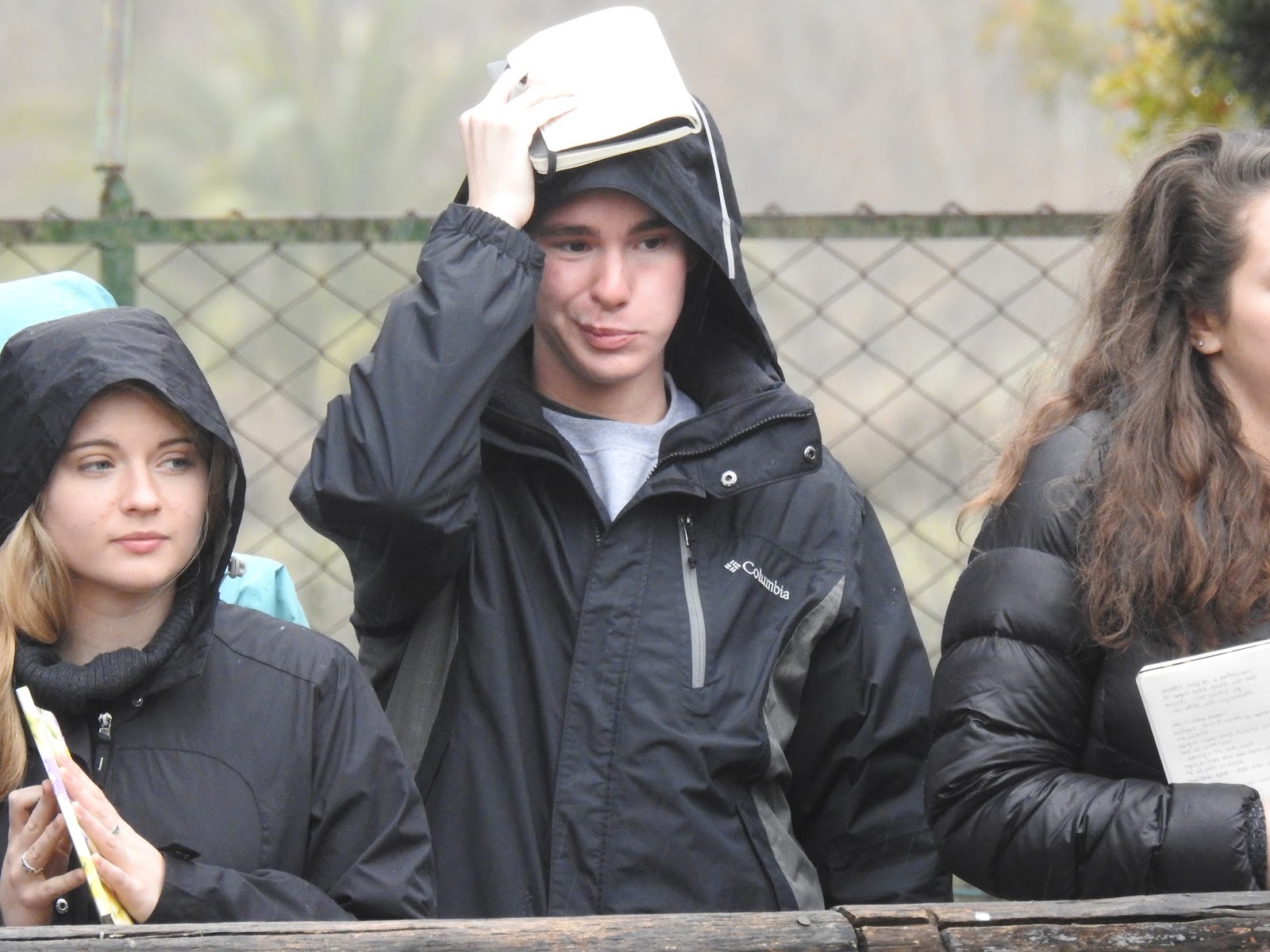
which makes Alex wants a notebook that get be used while wet.

That would be the best!

Kelsey is willing to sacrifice scholarship to keep her notebook dry.

Alyssa watches the aqueduct try to deal with this rain. 

Looks like Avery is plotting something...

<GASP!> They're going to murder Amanda!

which amuses Mary.

Facemeld

Thank goodness, Amanda is alright.

Bailee is smitten with Roman mosaics

in fact we all are.

Junie thinks I can't see her behind the bottles.

The agritourismo luncheon has arrived.

This glass is more than half-full...of levity.

Full bellies make for happy people.

Bailee just told Mara to shut up and looks pleased with herself.

That's just adorable.

We enjoy hanging out in the lobby in Syracuse

Is Erin sad again?

Nope, don't worry.

We like our hotel in Syracuse.

Lynn explains the complex functions of Greek theater.

She has a lot to say....

Who is that strange figure on the hill?

Avery is in their element.

Bailee and Mara scamper around the theater.

Kylee likes it too.

Alex shows us where his seat would be if he were
an ancient Syracusian.

Amanda likes to press wildflowers.

Nice!

Zach consoles a disappointed Junie who saw no bats or bears or ghosts
in the spooky cave.

Thursday, January 12, 2017

Syracuse + Cats

This morning we woke to beautiful crashing waves right outside our hotel! We began our day by strolling through the oldest of the five sections of Syracuse, Ortygia, making important stops along the way. At the temple dedicated to Apollo, we noted the Doric-style pillars (simple and straight aesthetic) and the variety of types of bricks evident in the structure. The inconsistency in materials as well as the misplaced alter (it was moved to touch the side of the steps while usually it is situated a distance in front) indicated that this space had been repurposed by regimes after Carthage and the Greeks.

We took a moment to discuss the key points in the history of Syracuse which followed the regimes of Gelon from Carthage, Heiro, and Heiro the second (surprisingly not blood related). After a siege by the Athenians in the 3rd century CE, Syracuse became a Roman naval base which ultimately led to a golden age. Arts, poetry, and math (with the help of Archimedes, the super smart math science guy who invented the catapult and a fancy volume formula) thrived as the city expanded. When Syracuse later turned against Rome in the 2nd Punic War, the city was devastated, producing many the ruins we saw today. We passed the city’s park, which used to be a Roman forum, and before that a Greek marketplace. The sheer distance from the forum to the theater, two main hubs of Roman life, indicated the large size of the ancient city.

Our visit to the archaeological park gave us the chance to see further elements of this complicated history left behind. Our time in the park was guided by a multitude of kitties, including one tabby from the theater who was extra friendly. Feline friends were literally everywhere, from shop windowsills to sunny spots on the steps and benches. We started with a 3rd century CE temple dedicated to Hiero the second, a political leader of Syracuse. Seeing a religious temple dedicated to a human figure caused us to think about the blurry lines between a patron god and a political patron. We then moseyed our way to the picturesque Greek theater. The 67 rows, originally separated into 9 sections named after Greek gods, made a horseshoe half-ring that faced the sea (theoretically for better acoustics). We discussed the development of Greek tragedies and comedies as well as the role of the shows in the lives of the people. Shows, which had both social, religious, and political function, would shape the values learned by its audience, giving a lot of prestige and power to the playwrights. Next to the theater was the giant cave shaped like a goat ear that the people carved out because they thought it would look cool and please the god Dionysus. JUST KIDDING. The giant crevice was actually a quarry the Syracusans used to retrieve their unique marble, found nowhere else in the world. Once we convinced everyone that the flying creatures in the cave were pigeons and not bats, we entered inside to find the chisel marks left from the excavation of marble. The area is currently used as a prison; yet another example of converted space throughout time. We ended our time in the park at a Roman amphitheater, which featured a full circle of seating around a stage that had all the goodies from trap doors to channels underneath. We learned that shows here were often elaborate and used to gain the favor of the people. On our way out we made time to explore the trinkets for sale; I myself was super excited to finally buy some postcards!

Our next stop was the church of St. Lucia, the duomo, of Syracuse. The church itself was a confluence of culture, featuring both Norman style pillars and a baroque style front area. There were also modern components, such as the display of the gifts that the people left for St. Lucia, many of which were figurines or valuables in the shape of eyes (St. Lucia is known for her eyes being poked out during her prosecution). Even before the structure was a church, the building was a temple dedicated to Athena, further demonstrating the repurposing of space.

After some free time for exploring and lunch (and gelato of course), we walked to the guidecca, the section that Jews were confined to, to see the oldest known mikvah in Europe! It was originally chiseled out in the 1st century. This was so cool. Like beyond cool.
Quick overview: A mikvah is a place where Jews, both males and females would separately go for spiritual or ritual cleansing. Typical uses for females would be before marriage, after childbirth, and after every menstruation period. In the Orthodox tradition (which was all that existed at that point because other movements hadn’t come about yet), a woman was considered “impure” during her period (in this sense impure does not retain a negative connotation), and then could become pure again by immersing in the bath of natural flowing spring water. Other instances of impurity that could require a mikvah would be after dealing with death. Men would use the mikvahs whenever they wanted, usually before weekly Shabbos prayer and before marriage.
After the Spanish Inquisition, Jews were forced to leave or convert, so this mikvah was hidden away in hopes it would not be desecrated. This place was hidden for CENTURIES, and was only discovered 28 years ago when the modern building above made a well for water that went through the mikvah. It was excavated and has been used in recent months. It is just SO amazing that something could be so perfectly hidden and preserved for so long and then stumbled upon by accident.
When we followed the steps down into the subterranean mikvah to find five personal pools with steps, two of which were separate private mikvahs. Due to unexpected circumstances the entire floor was flooded a couple inches. This was actually the best mishap ever, as it gave us the most unique experience I could ever ask for. We were able to take our shoes off and explore the space wading in the same water that flows through the baths themselves, the same water source that Jews thousands of years ago, and still today, immersed themselves in. As soon as you entered the space, wiggling your toes in the shallow water and pressing your heels into the rough stone floor, you felt that you were crossing a boundary into sacred space. Even some of my fellow peers, regardless of whether they were Jewish, spoke to me of this internal feeling in some form or another. Sadly leaving the mikvah, I thought of the twinkling droplets of water that had condensed on the low ceiling of the private baths, creating a sparkling scene similar to a crystalized cave or a starry night.


The rest of the day we explored the beautiful city of Syracuse, the last we will see of Sicily! Many people (including myself) took the opportunity to shop, take pictures down on the rocky coast speckled with sea glass (also me), and visit the gorgeous nearby castle looking structures near the water (unfortunately not me, though it gives me a reason to come back!). It will be hard to say goodbye to beautiful Sicily tomorrow morning, but there is so much more in store for us as we make our way to Naples. And I can’t wait!

-Bing