Friday, January 13, 2017

Neopolitans... Long Live Italy!

(Title quoted from the speech Giuseppe Garibaldi gave on September 7th on his first entry to Naples after capturing the capital city)
This morning we woke up to another sunrise over the Mediterranean. We packed, ate breakfast, and said goodbye to our oceanside hotel and Siracusa, which had given us so much during our stay. We ate lunch at the airport, our last opportunity for Sicilian delicacies like arancini. We also talked to a nice woman on the plane who told us that Turkey had some excellent sites for what we were studying. At this point ma'am, we're well aware. The flight to Naples was short, though very bumpy. But we've finally made it to mainland Italy!
Naples is a far bigger and busier city than any we saw in Sicily. It was the capital of the Kingdom of Two Sicilies and spent many of its modern formative years under Spanish rule, later becoming the site where Garibaldi's volunteer army joined with the Piedmontese army from the north of Italy during the campaign for Unification in 1860. Once we got to the hotel, we had the rest of the evening off, for catching up on coursework, shopping, and what-have-you. Since today was mostly dedicated to travelling and recovering from the full-tilt we've been tackling this course at up until this point, there aren't a whole lot of events to talk about in this post. So it's probably time to reflect on our time in Sicily.
Sicily was very kind to us during our time there. We may not have had the sunny warm weather of previous years, but driving through mountains and arriving at gorgeous oceanside views was better than I think any of us were prepared for. The confluence of cultures from all of its previous rulers still shapes modern Sicily, and it certainly shaped how we saw it, whether through a religious, historic, or modern lens. As you explored the cities, you couldn't help but notice how many streets were named after previous rulers of those areas, and as you watched the highway signs go by while travelling, you noted that many of the town names are based off of Arabic words- many that start with the prefix 'calta' used to have arabic castles in them (from the arabic word aal-ah). Sicily served as an excellent starting place for our course, with its independence and calmer cities helping acclimate many of us to being in Italy. It will be very interesting to see how things change as we move closer to the center of power for both the ancient Roman Empire and the modern Italian state: Rome. For now, I'm excited to see what Naples and mainland Italy have in store for us.
Ciao!

-Avery

Two days of pictures

Alex is getting his head together for our visit to the Villa Casale

A charming dog interrupts Lynn to tell us it's about to
start raining.  Dogs know.

The villa's bath complex shakes up our conceptions of what a bath is for...

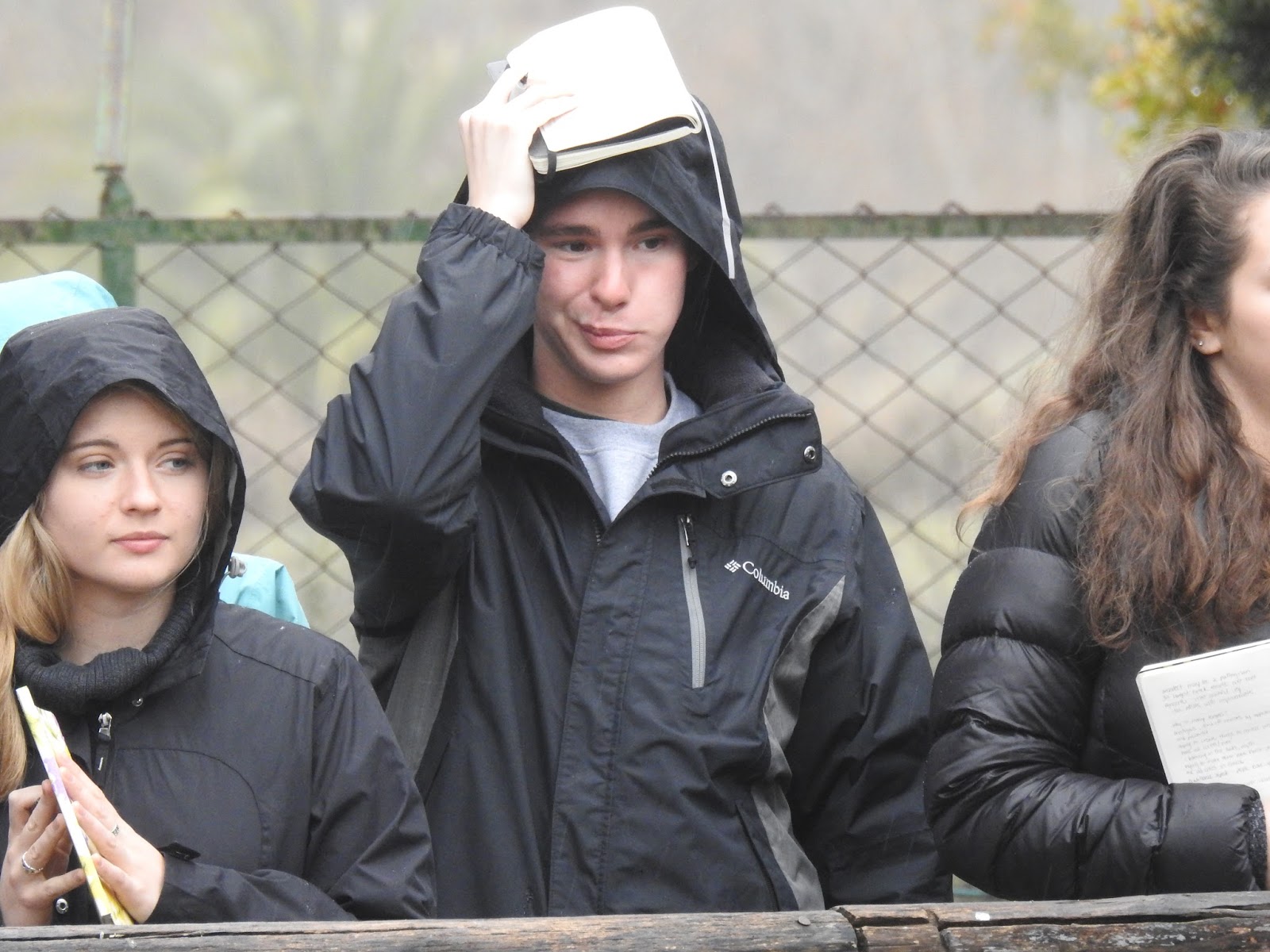
which makes Alex wants a notebook that get be used while wet.

That would be the best!

Kelsey is willing to sacrifice scholarship to keep her notebook dry.

Alyssa watches the aqueduct try to deal with this rain. 

Looks like Avery is plotting something...

<GASP!> They're going to murder Amanda!

which amuses Mary.

Facemeld

Thank goodness, Amanda is alright.

Bailee is smitten with Roman mosaics

in fact we all are.

Junie thinks I can't see her behind the bottles.

The agritourismo luncheon has arrived.

This glass is more than half-full...of levity.

Full bellies make for happy people.

Bailee just told Mara to shut up and looks pleased with herself.

That's just adorable.

We enjoy hanging out in the lobby in Syracuse

Is Erin sad again?

Nope, don't worry.

We like our hotel in Syracuse.

Lynn explains the complex functions of Greek theater.

She has a lot to say....

Who is that strange figure on the hill?

Avery is in their element.

Bailee and Mara scamper around the theater.

Kylee likes it too.

Alex shows us where his seat would be if he were
an ancient Syracusian.

Amanda likes to press wildflowers.

Nice!

Zach consoles a disappointed Junie who saw no bats or bears or ghosts
in the spooky cave.

Thursday, January 12, 2017

Syracuse + Cats

This morning we woke to beautiful crashing waves right outside our hotel! We began our day by strolling through the oldest of the five sections of Syracuse, Ortygia, making important stops along the way. At the temple dedicated to Apollo, we noted the Doric-style pillars (simple and straight aesthetic) and the variety of types of bricks evident in the structure. The inconsistency in materials as well as the misplaced alter (it was moved to touch the side of the steps while usually it is situated a distance in front) indicated that this space had been repurposed by regimes after Carthage and the Greeks.

We took a moment to discuss the key points in the history of Syracuse which followed the regimes of Gelon from Carthage, Heiro, and Heiro the second (surprisingly not blood related). After a siege by the Athenians in the 3rd century CE, Syracuse became a Roman naval base which ultimately led to a golden age. Arts, poetry, and math (with the help of Archimedes, the super smart math science guy who invented the catapult and a fancy volume formula) thrived as the city expanded. When Syracuse later turned against Rome in the 2nd Punic War, the city was devastated, producing many the ruins we saw today. We passed the city’s park, which used to be a Roman forum, and before that a Greek marketplace. The sheer distance from the forum to the theater, two main hubs of Roman life, indicated the large size of the ancient city.

Our visit to the archaeological park gave us the chance to see further elements of this complicated history left behind. Our time in the park was guided by a multitude of kitties, including one tabby from the theater who was extra friendly. Feline friends were literally everywhere, from shop windowsills to sunny spots on the steps and benches. We started with a 3rd century CE temple dedicated to Hiero the second, a political leader of Syracuse. Seeing a religious temple dedicated to a human figure caused us to think about the blurry lines between a patron god and a political patron. We then moseyed our way to the picturesque Greek theater. The 67 rows, originally separated into 9 sections named after Greek gods, made a horseshoe half-ring that faced the sea (theoretically for better acoustics). We discussed the development of Greek tragedies and comedies as well as the role of the shows in the lives of the people. Shows, which had both social, religious, and political function, would shape the values learned by its audience, giving a lot of prestige and power to the playwrights. Next to the theater was the giant cave shaped like a goat ear that the people carved out because they thought it would look cool and please the god Dionysus. JUST KIDDING. The giant crevice was actually a quarry the Syracusans used to retrieve their unique marble, found nowhere else in the world. Once we convinced everyone that the flying creatures in the cave were pigeons and not bats, we entered inside to find the chisel marks left from the excavation of marble. The area is currently used as a prison; yet another example of converted space throughout time. We ended our time in the park at a Roman amphitheater, which featured a full circle of seating around a stage that had all the goodies from trap doors to channels underneath. We learned that shows here were often elaborate and used to gain the favor of the people. On our way out we made time to explore the trinkets for sale; I myself was super excited to finally buy some postcards!

Our next stop was the church of St. Lucia, the duomo, of Syracuse. The church itself was a confluence of culture, featuring both Norman style pillars and a baroque style front area. There were also modern components, such as the display of the gifts that the people left for St. Lucia, many of which were figurines or valuables in the shape of eyes (St. Lucia is known for her eyes being poked out during her prosecution). Even before the structure was a church, the building was a temple dedicated to Athena, further demonstrating the repurposing of space.

After some free time for exploring and lunch (and gelato of course), we walked to the guidecca, the section that Jews were confined to, to see the oldest known mikvah in Europe! It was originally chiseled out in the 1st century. This was so cool. Like beyond cool.
Quick overview: A mikvah is a place where Jews, both males and females would separately go for spiritual or ritual cleansing. Typical uses for females would be before marriage, after childbirth, and after every menstruation period. In the Orthodox tradition (which was all that existed at that point because other movements hadn’t come about yet), a woman was considered “impure” during her period (in this sense impure does not retain a negative connotation), and then could become pure again by immersing in the bath of natural flowing spring water. Other instances of impurity that could require a mikvah would be after dealing with death. Men would use the mikvahs whenever they wanted, usually before weekly Shabbos prayer and before marriage.
After the Spanish Inquisition, Jews were forced to leave or convert, so this mikvah was hidden away in hopes it would not be desecrated. This place was hidden for CENTURIES, and was only discovered 28 years ago when the modern building above made a well for water that went through the mikvah. It was excavated and has been used in recent months. It is just SO amazing that something could be so perfectly hidden and preserved for so long and then stumbled upon by accident.
When we followed the steps down into the subterranean mikvah to find five personal pools with steps, two of which were separate private mikvahs. Due to unexpected circumstances the entire floor was flooded a couple inches. This was actually the best mishap ever, as it gave us the most unique experience I could ever ask for. We were able to take our shoes off and explore the space wading in the same water that flows through the baths themselves, the same water source that Jews thousands of years ago, and still today, immersed themselves in. As soon as you entered the space, wiggling your toes in the shallow water and pressing your heels into the rough stone floor, you felt that you were crossing a boundary into sacred space. Even some of my fellow peers, regardless of whether they were Jewish, spoke to me of this internal feeling in some form or another. Sadly leaving the mikvah, I thought of the twinkling droplets of water that had condensed on the low ceiling of the private baths, creating a sparkling scene similar to a crystalized cave or a starry night.


The rest of the day we explored the beautiful city of Syracuse, the last we will see of Sicily! Many people (including myself) took the opportunity to shop, take pictures down on the rocky coast speckled with sea glass (also me), and visit the gorgeous nearby castle looking structures near the water (unfortunately not me, though it gives me a reason to come back!). It will be hard to say goodbye to beautiful Sicily tomorrow morning, but there is so much more in store for us as we make our way to Naples. And I can’t wait!

-Bing

Wednesday, January 11, 2017

Viva il Villa

Today we arrived in Piazza Armerina to see the beautiful Villa del Casale. The air a foggy mist, it wasn't long before a friendly doggo emerged. This doggo was not ordinary and was obviously used to the like of tourists, and soon many a pet was given. After the brief encounter, the cohort got to work investigating what was left of what was once an incredible Roman "domus," or home.  
The story of the Villa begins in 1st century, when the Roman empire began in 27 BCE. The building itself was built in the early 4th century. A fascinating maze of mosaics and marble, the Villa serves as an ode to the Greek life, a nod at the luxury and excess that oozed from the civilization. Historians believe that an important family or even an emperor may have owned the home, perhaps due to the tiled depiction of Hercules in the dining room; a godly comparison to a ruler. This villa in particular is the best preserved and contains the most mosaics in the Roman world. Located on a road between Agrigento and Catania, the villa is at the optimal place to serve as a pit stop for weary travelers. 
We entered through the back of the home, past the bath rooms. In ancient Rome, bathing was no simple hygienic process. It was a social event, even public at times, including everything from conversation-oriented latrines to rubbing and dressing rooms. Guests would often be invited to bathe before dinner. The bathing rooms used the most innovative forms of technology for that time, with an aqueduct located near the house and a hypocaust system that warmed the floor with steam. This manipulation of natural resources is evidence of the Romans’ ability to control nature, a feat in any period of time.
The architecture of the villa can be condensed into two parts: pars urbana and pars rustica. The latter addresses the agricultural side of the working villa, whereas the former is composed of the leisure and entertainment. The Atrium, or peristyle, is a courtyard or garden of sorts located in the middle of the villa with an open roof. The focal point is a fountain, which serves as further evidence of the Roman specialization in water. This use of space defines the landscape’s role in a villa as a complimentary piece to the luxurious architecture. 
The halls that line the atrium are tiled, depicting different beasts. The Great Hall was also tiled with several different animals, and one room is tiled in a hunting scene. The mosaics often serve as clues to the family that may have resided in the villa.  A private entrance depicts a wife with children. More often than not, an extended part of the family as well as slaves would have lived in the gargantuan residence. 
The most prominent part of today would have to be the social status that lived within the walls of the villa. We learned that despite all conquests, wars and politics, ancient Romans were still just as aware of their social output in history as we are today. Exploring the villa and interpreting its architecture may beg the question: what are we leaving the future to find, and what will they think? A masterpiece of grandiosity and splendor, the villa stands as evidence of a self-conscious lifestyle, perhaps most blatantly lived. What will the discovery of every mall, gas station and modern artwork leave future generations to believe of us, and is it what we want?
After leaving the villa, we stopped in Piazza Armerina for a traditional Italian lunch of several interesting appetizers, sausage and pork chops, potatoes and salad. The food was good, but the company may have been better. We rode on the bus for another few hours until our rainy arrival in Syracuse. As I type this, I can hear the ocean roaring from my window, and I’m pretty sure I heard it tell me to go eat dinner. Here’s to many more safe and exciting explorations to come!


- Junie


Tuesday, January 10, 2017

Sicily is Greece

Stunning view of the Sea of Africa from the Hera temple

Looks like Vanessa like Hera.

Mara has a John Denver tune in her head.

Temple Concordia is most agreeable.

Question 1. Where's Erin?  Question 2. What's she doing?

While in a necropolis, Bailee contemplates the finitude of life. 

Julia is not bothered by the finitude of life.


Louisa wants her friends to hurry up so we can behold the Olympieion.

A rare smile from Sarah Hope.

Alyssa shows appropriate reverence for Zeus...
or she just wishes someone would sacrifice us some lunch.

"Eat like you're going to die tomorrow, build temples like you're going to live forever"

Today we visited the “Valle Dei Templei” in Agrigento! Since we arrived at the hotel yesterday and admired the amazing view of the temples from the gardens we were really excited to go visit them up close. The temples where built between two rivers and high in the mountains so that they could be seen and admired from far away. The original name of the city was Akragas and it houses the temples dedicated to Hera, Concordia, Heracles and Zeus as well as the Temple of Castor and Polluck and the early Christian catacombs carved out of the city wall.

There are many reasons why it is believed that the Greeks decided to settle here in Sicily. In Greece there wasn't enough farmland to support the population and it was rumored that in Sicily “wheat grew wild”. Greek veterans were therefore given land in Sicily to settle and start new civilizations so they chose Akragas due to its proximity to the se and fertile land. 

The first temple we visited was the Temple of Hera or Juno from 5th century BC. It was built using the local sandstone by Carthaginian slaves and covered with white plaster to make it look like it was made out of marble, resembling those found in Greece. The plaster was painted to create colorful, garish frescos to call for the attention of the people. It is very interesting to see how the Greeks found beauty in symmetry, building this typical Doric temple with 6 columns on the front and back and 13 along the sides. What most people don't realize most of the times is that right in front of the temple was…. the altar!! Woohoo! As Lynn explained, the altar is of great importance because that was the the actual citizens of the polis interacted with the gods, performing their sacrifices “barbecuing” by killing animals and offering the fat and bones to the gods through the fire.

As we continued to walk around the valley we saw the city walls, carved from the mountain by the colons to defend themselves from the locals. Years went by and after a plague of Malaria infested the city to became a Necropolis, turning the nine gate wall into the city in multiple catacombs once again carved from the stone where bodies where buried and sealed to prevent the spread of the disease after the abandonment of the city. The catacombs had uncovered arches above them the showed early Christian motifs like the fish, form 6th century BC.

The Temple of Concordia is one of the best preserved Greek temples of the world. Its name originates from a Latin inscription found near it the reads ‘the harmony of the people of Agrigento’. The alterations made at the 4th century AD, when it was turned into a Christian basilica probably helped the 34 columns to stay in place, showing us the beauty of the original temple after it was restored to its Classical form in 1748. As the Greeks built each temple, they learned from their mistakes and made improvements, resulting in a perfected version of earlier temples.

The Temple of Hercules  has only eight columns still standing, put back in place in 1924, as a result of an initiative of the English captain Alexander Hardcastle. At last, the Temple of Olympian Zeus has only some fragments of ruins standing. Yet it has been concluded by the remains of the ruins that this was the biggest and most unique of them all.  Although the disastrous conditions of the temple have made it very difficult to study, many have made assumptions and from the bits and pieces found in excavations, drawn some conclusions. The temple had an interior wall, creating vast interior spaces. Also the appearance of the ‘Atlantes’, gigantic human figures that ‘held’ the ceiling are thought to represent people from other ethnicities shown as defeated and oppressed by the people of Akragas. The front of the temple has an uneven number of columns which made it impossible to have the door in the middle, building instead two doors, one on each side. The odd choice of using the uneven number 7 and then 14 pillars down the aisles probably resulted from the Pythagorean theory of numbers, although this is not certain, making us wonder maybe someone arrived to the city and introduced this revolutionary ideas? 

At last, at the very end of the Temple Valley is a reconstruction of the Temple of Castor and Pollock, which was reconstructed using the parts of different temples found around the valley. Ironically, this ‘fake’ temple is now represented in most postcards and souvenirs and its image is probably known better than that of the other temples; but as our tour guide said “That’s life!”. The temples where more than I ever imagined and there is still a lot to interpret and uncover meanwhile I just keep blown away by the number of cultures and people that left their mark on this island, and can’t wait to see what tomorrow has for us!


-Isabel

Getting real in Monreale

Zach hopes William II's mountain-top palace provided him the security he lacked in Palermo.


Vanessa does not like William II


While Erin's leap expresses the joy at seeing the Monreale Cathedral for the first time,
it is unclear what Mary's "leap" reflects.

Monreale Cathedral--sumptuous

Lynn and Bailee examine some of the curiosities of the cloister's arcade.